
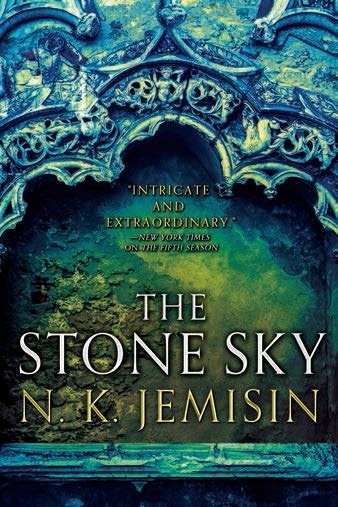
The Stone Sky
“The Stone Sky” by N.K. Jemisin is the concluding volume of the Broken Earth trilogy, a groundbreaking fantasy series. The story follows Essun, a mother and orogene with earth-manipulating powers, as she races against time to save her daughter Nassun and prevent the apocalyptic destruction of their world. Themes of oppression, resilience, and the cyclical nature of violence are explored through Jemisin’s intricate world-building and layered characters. The novel delves into the origins of the moon’s disappearance and the catastrophic consequences for the planet. Jemisin’s innovative narrative structure and profound exploration of societal trauma earned the trilogy unprecedented back-to-back Hugo Awards. The Stone Sky masterfully ties together the series’ complex threads while delivering a poignant commentary on power, sacrifice, and redemption.
The Stone Sky is the explosive, Hugo Award-winning conclusion to N.K. Jemisin’s groundbreaking Broken Earth trilogy—the first series in history to win three consecutive Hugo Awards for Best Novel. As the Fifth Season’s apocalyptic devastation reaches its peak, the story converges on two women whose choices will determine the fate of the Stillness:
- Essun, the orogene mother turned revolutionary, who must wield the power of the Obelisk Gate to either save humanity or destroy it.
- Nassun, her estranged daughter, whose bitter rage has led her to ally with forces that could end the world forever.
With crystalline prose and seismic emotional force, Jemisin explores the cyclical nature of oppression, the cost of vengeance, and whether broken systems can—or should—be repaired. The novel’s mythic scale, geological magic, and unflinching social commentary cement its legacy as a masterpiece of speculative fiction.
Description
- “The Stone Sky” by N.K. Jemisin is the concluding volume of the Broken Earth trilogy, a groundbreaking fantasy series. The story follows Essun, a mother and orogene with earth-manipulating powers, as she races against time to save her daughter Nassun and prevent the apocalyptic destruction of their world. Themes of oppression, resilience, and the cyclical nature of violence are explored through Jemisin’s intricate world-building and layered characters. The novel delves into the origins of the moon’s disappearance and the catastrophic consequences for the planet. Jemisin’s innovative narrative structure and profound exploration of societal trauma earned the trilogy unprecedented back-to-back Hugo Awards. The Stone Sky masterfully ties together the series’ complex threads while delivering a poignant commentary on power, sacrifice, and redemption.
FAQs
- What is “The Stone Sky” about?
- • “The Stone Sky” is the third book in N. K. Jemisin’s “Broken Earth” trilogy. It continues the epic narrative of a world plagued by catastrophic geological events, following characters like Essun as they navigate survival, power, and the mysteries of a fractured planet. The prologue hints at a deep exploration of the world’s origins and the cyclical nature of its destruction.
- Who is the author of “The Stone Sky”?
- • The book is written by N. K. Jemisin, a highly acclaimed author known for her groundbreaking work in speculative fiction, particularly the “Broken Earth” trilogy, which has won multiple Hugo Awards.
- Is “The Stone Sky” part of a series?
- • Yes, it is the final installment in the “Broken Earth” trilogy, preceded by “The Fifth Season” and “The Obelisk Gate.” The trilogy is celebrated for its innovative storytelling and rich world-building.
- What themes are explored in “The Stone Sky”?
- • The book delves into themes of survival, oppression, systemic injustice, and the resilience of humanity in the face of apocalyptic events. It also examines the cyclical nature of history and the consequences of wielding immense power.
- What makes “The Stone Sky” unique in its genre?
- • N. K. Jemisin’s narrative style, which blends second-person perspective with rich, immersive world-building, sets this book apart. The trilogy is also notable for its exploration of socio-political themes through the lens of a fantastical, geologically unstable world.
- What is the tone of “The Stone Sky”?
- • The tone is both epic and intimate, combining grand-scale world-building with deeply personal character arcs. The prologue suggests a reflective, almost mythic quality, as the narrator recounts the origins of the world and its inevitable transformations.
- Who would enjoy reading “The Stone Sky”?
- • Fans of speculative fiction, dystopian narratives, and richly detailed world-building will appreciate this book. It’s also ideal for readers who enjoy complex characters and thought-provoking themes woven into their stories.
- How does “The Stone Sky” conclude the trilogy?
- • Without spoilers, the book ties together the overarching plotlines of the trilogy, resolving the fates of key characters and the mysteries of the obelisks and the Stillness. It offers a satisfying and emotionally resonant conclusion to the series.
Quotes
- “TIME GROWS SHORT, MY LOVE. Let’s end with the beginning of the world, shall we? Yes. We shall.” — N. K. Jemisin, The Stone Sky
- “My memories are like insects fossilized in amber. They are rarely intact, these frozen, long-lost lives.” — N. K. Jemisin, The Stone Sky
- “When we say that ‘the world has ended,’ remember—it is usually a lie. The planet is just fine.” — N. K. Jemisin, The Stone Sky
- “Can you truly understand what a nation is capable of, child of the Stillness?” — N. K. Jemisin, The Stone Sky
- “Here, now, dreams have no limit.” — N. K. Jemisin, The Stone Sky
- Chapter 1: PROLOGUE: ME, WHEN I WAS I 2,390 Words
- Chapter 2: YOU, IN WAKING AND DREAMING 2,197 Words
- Chapter 3: NASSUN FEELS LIKE BUSTING LOOSE 2,519 Words
- Chapter 4: SYL ANAGIST: FIVE 2,503 Words
- Chapter 5: YOU, IMBALANCED 2,413 Words
- Chapter 6: NASSUN, WANDERING IN THE WILDERNESS 2,428 Words
- Chapter 7: SYL ANAGIST: FOUR 2,506 Words
- Chapter 8: YOU ARE REMEMBERED 2,099 Words
- Chapter 9: NASSUN MAKES HER FATE 2,298 Words
- Chapter 10: SYL ANAGIST: THREE 2,062 Words
- Chapter 11: YOU’RE PLANNING AHEAD 2,426 Words
- Chapter 12: NASSUN UNDERGROUND 2,412 Words
- Chapter 13: SYL ANAGIST: TWO 2,271 Words
- Chapter 14: THE DESERT, BRIEFLY, AND YOU 2,532 Words
- Chapter 15: NASSUN, THROUGH THE FIRE 2,286 Words
- Chapter 16: SYL ANAGIST: ONE 2,125 Words
- Chapter 17: YOU’RE ALMOST HOME 2,127 Words
- Chapter 18: NASSUN, NOT ALONE 2,107 Words
- Chapter 19: SYL ANAGIST: ZERO 2,306 Words
- Chapter 20: NASSUN AND ESSUN, ON THE DARK SIDE OF THE WORLD 2,367 Words
- Chapter 21: I, AT THE END OF DAYS 2,341 Words
- Chapter 22: ODA: ME, AND YOU 2,089 Words
-
Never Let Me Go: In Never Let Me Go, Kazuo Ishiguro weaves a haunting and introspective tale set in an alternate-reality 1990s England, where Kathy…
-
The Chrysalids: In The Chrysalids, John Wyndham crafts a chilling post-apocalyptic world where genetic purity is enforced with religious fervor.…
-
The Giver of Stars: Set in the rugged mountains of 1930s Kentucky, The Giver of Stars follows Alice Wright, a spirited Englishwoman who escapes her…
-
The Children of Men: In The Children of Men, P.D. James crafts a haunting dystopian vision set in 2021, where humanity faces extinction after decades of…
-
The Hunger Games: In The Hunger Games, Katniss Everdeen, a 16-year-old girl from the impoverished District 12, volunteers to take her younger sister’s…
-
The Death Cure: In The Death Cure, the harrowing conclusion to the Maze Runner trilogy, Thomas and his friends escape WICKED’s…
-
Brave New World: In Brave New World, Aldous Huxley crafts a chilling vision of a dystopian future where society is engineered for stability and…
-
Gregor and the Curse of the Warmbloods: In Gregor and the Curse of the Warmbloods, Gregor returns to the Underland on a desperate mission: a deadly plague called the…
-
Gregor and the Marks of Secret: In Gregor and the Marks of Secret, Gregor returns to the Underland for a mission that begins as a rescue—and spirals into a chilling…
-
Gregor and the Code of Claw: In the epic conclusion to the Underland Chronicles, Gregor faces his most harrowing challenge yet as the Underland teeters on…