
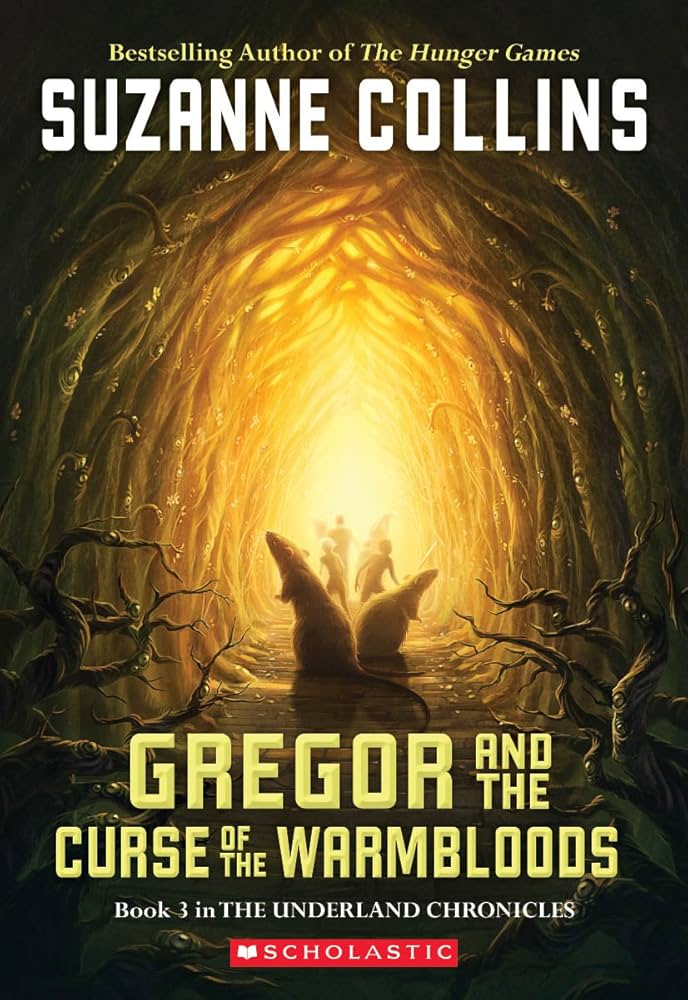
Gregor and the Curse of the Warmbloods
In Gregor and the Curse of the Warmbloods, Gregor returns to the Underland on a desperate mission: a deadly plague called the “Curse of the Warmbloods” is ravaging the land, threatening humans, bats, and even his own mother, who falls ill after joining him.
Guided by a new prophecy, Gregor and his allies—including Luxa, Ares, and Boots—journey to the Jungle of Hadesland, a toxic region filled with lethal plants and creatures. Their goal: retrieve a rare cure hidden in the treacherous Vineyard of Eyes. But the jungle holds more than medicine—it reveals shocking truths about the origin of the plague and the sinister forces manipulating the Underland’s fate.
As Gregor battles venomous creatures and moral dilemmas, he must confront a harrowing question: Is the cure worth the cost?
Description
- In “Gregor and the Curse of the Warmbloods” by Suzanne Collins, the third installment of the Underland Chronicles, young Gregor returns to the subterranean world beneath New York City. Tasked with aiding his allies, the Underlanders, he embarks on a perilous quest to find a cure for a deadly plague threatening both humans and creatures. The novel explores themes of loyalty, sacrifice, and the consequences of war, as Gregor grapples with moral dilemmas and the weight of leadership. Collins blends adventure and introspection, delivering a gripping tale that underscores the fragility of life and the bonds between species.
FAQs
- What is “Gregor and the Curse of the Warmbloods” about?
- • This book is the third installment in Suzanne Collins’ “Underland Chronicles” series. It follows Gregor, a young boy who discovers a hidden world called the Underland beneath New York City. In this adventure, Gregor confronts a new prophecy, “The Prophecy of Blood,” which hints at a deadly plague threatening the warmblooded creatures of the Underland, including humans, bats, and rats.
- Who is the target audience for this book?
- • The book is aimed at middle-grade readers (ages 8-12) but can also be enjoyed by young adults and fans of fantasy adventure stories. Its themes of bravery, family, and moral dilemmas resonate with a broad audience.
- What makes this book unique in the series?
- • This installment delves deeper into the political and ethical complexities of the Underland, particularly the tension between humans and other creatures. The prophecy’s cryptic nature (written backward and requiring a mirror to read) adds a layer of mystery and urgency to the plot.
- How does Gregor’s family play a role in the story?
- • Gregor’s family, especially his younger sisters Boots and Lizzie, are central to his motivations. His father’s recovery from illness (thanks to Underland medicine) and the family’s financial struggles ground the fantastical elements in relatable emotional stakes.
- Is this book suitable for readers who haven’t read the previous books in the series?
- • While it can be read as a standalone, readers will benefit from starting with the first two books (“Gregor the Overlander” and “Gregor and the Prophecy of Bane”) to fully understand the world, characters, and ongoing conflicts.
- What themes are explored in this book?
- • Key themes include sacrifice, loyalty, the consequences of war, and the moral ambiguity of prophecies. Gregor’s internal conflict—whether to trust the Underlanders or the rats—adds depth to the narrative.
- How does the Underland’s setting influence the story?
- • The harsh, subterranean world of the Underland, with its giant creatures and warring factions, creates a tense and immersive backdrop. The humans’ struggle for survival against the rats and other threats drives the plot forward.
- What is the tone of the book?
- • The tone is a mix of adventure, suspense, and emotional weight. Gregor’s personal struggles (protecting his family, deciphering the prophecy) balance the larger-scale conflicts of the Underland.
- Are there any trigger warnings for sensitive readers?
- • The book contains themes of illness, war, and violence, though it is not overly graphic. Younger or sensitive readers might find some scenes intense, particularly those involving the plague and moral dilemmas.
- How does this book set up future events in the series?
- • The unresolved prophecy and Gregor’s growing role as a key figure in the Underland hint at larger conflicts to come. The tension between humans and rats, as well as Gregor’s unresolved feelings about the Bane, suggest deeper challenges ahead.
Quotes
- “Gregor stared in the bathroom mirror for a minute, steeling himself. Then he slowly unrolled the scroll and held the handwritten side up to the glass. In the reflection, he read the first stanza of a poem entitled ‘The Prophecy of Blood.’ As usual, the lines made him feel sick to his stomach.” — Suzanne Collins
- “‘So you can reflect on it sometimes,’ Nerissa had said. Turned out she’d meant it literally — ‘The Prophecy of Blood’ was written backward. You couldn’t even make sense of it unless you had a mirror.” — Suzanne Collins
- “Boots wiggled up onto the toilet seat. ‘I big girl now. I can go pee.’ ‘Good job,’ said Gregor, giving her a thumbs-up. Boots beamed back at him.” — Suzanne Collins
- “His dad was just pulling a tray of drop biscuits out of the oven. It was good to see him up, doing something even as simple as making his kids’ breakfast. More than two and a half years as a prisoner of the huge, bloodthirsty rats in the Underland had left his dad a very sick man.” — Suzanne Collins
- “Gregor’s secret hope was that if the medicine kept working, his dad might get to go back to his job as a high school science teacher in the fall.” — Suzanne Collins
- Chapter 1 2,200 Words
- Chapter 2 2,057 Words
- Chapter 3 2,062 Words
- Chapter 4 2,241 Words
- Chapter 5 2,138 Words
- Chapter 6 1,963 Words
- Chapter 7 2,117 Words
- Chapter 8 2,051 Words
- Chapter 9 2,104 Words
- Chapter 10 2,044 Words
- Chapter 11 2,177 Words
- Chapter 12 1,933 Words
- Chapter 13 2,163 Words
- Chapter 14 2,236 Words
- Chapter 15 2,470 Words
- Chapter 16 2,266 Words
- Chapter 17 2,110 Words
- Chapter 18 2,272 Words
- Chapter 19 2,331 Words
- Chapter 20 2,094 Words
- Chapter 21 2,488 Words
- Chapter 22 1,935 Words
- Chapter 23 2,129 Words
- Chapter 24 2,081 Words
- Chapter 25 2,340 Words
- Chapter 26 2,257 Words
- Chapter 27 2,063 Words
-
Never Let Me Go: In Never Let Me Go, Kazuo Ishiguro weaves a haunting and introspective tale set in an alternate-reality 1990s England, where Kathy…
-
The Chrysalids: In The Chrysalids, John Wyndham crafts a chilling post-apocalyptic world where genetic purity is enforced with religious fervor.…
-
The Giver of Stars: Set in the rugged mountains of 1930s Kentucky, The Giver of Stars follows Alice Wright, a spirited Englishwoman who escapes her…
-
The Children of Men: In The Children of Men, P.D. James crafts a haunting dystopian vision set in 2021, where humanity faces extinction after decades of…
-
The Hunger Games: In The Hunger Games, Katniss Everdeen, a 16-year-old girl from the impoverished District 12, volunteers to take her younger sister’s…
-
The Death Cure: In The Death Cure, the harrowing conclusion to the Maze Runner trilogy, Thomas and his friends escape WICKED’s…
-
Brave New World: In Brave New World, Aldous Huxley crafts a chilling vision of a dystopian future where society is engineered for stability and…
-
Gregor and the Curse of the Warmbloods: In Gregor and the Curse of the Warmbloods, Gregor returns to the Underland on a desperate mission: a deadly plague called the…
-
Gregor and the Marks of Secret: In Gregor and the Marks of Secret, Gregor returns to the Underland for a mission that begins as a rescue—and spirals into a chilling…
-
Gregor and the Code of Claw: In the epic conclusion to the Underland Chronicles, Gregor faces his most harrowing challenge yet as the Underland teeters on…