
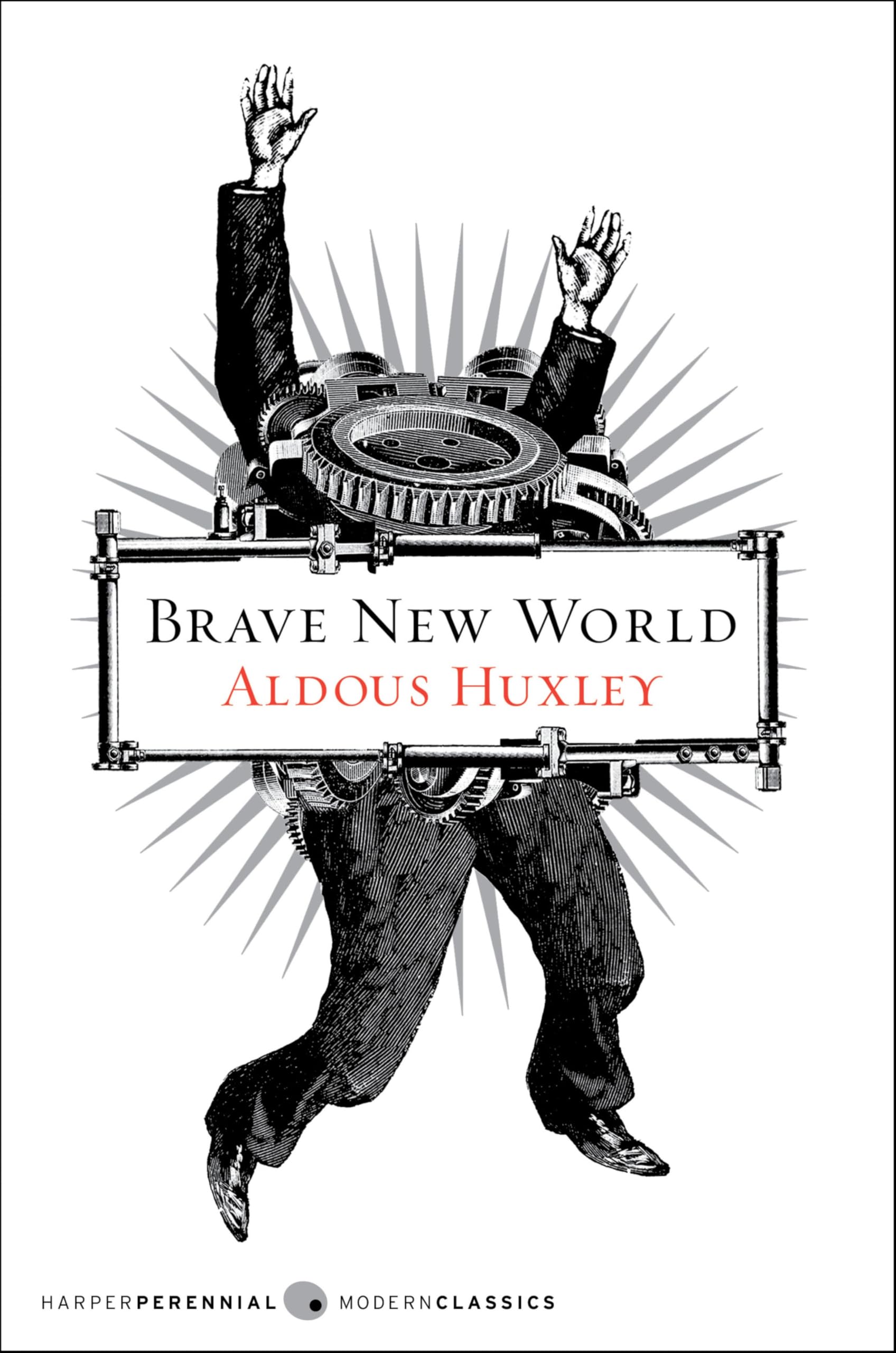
Brave New World
In Brave New World, Aldous Huxley crafts a chilling vision of a dystopian future where society is engineered for stability and superficial happiness. Set in London, 2540 AD, humans are no longer born but grown in laboratories, genetically designed and psychologically conditioned to fit into rigid castes: Alphas, Betas, Gammas, Deltas, and Epsilons.
The World State enforces conformity through:
- Soma: A drug that numbs emotions and suppresses dissent.
- Hypnopaedia: Sleep-teaching that ingrains societal norms.
- Consumerism and promiscuity: Used to distract citizens from deeper thought.
When Bernard Marx, an Alpha with unorthodox views, brings John “the Savage”—a man born naturally and raised on a Native American reservation—into this “perfect” world, the collision of values exposes the cracks in the system. John’s struggle with love, art, and individuality forces the citizens of the World State to confront the hollowness of their existence.
A cornerstone of dystopian literature, Brave New World challenges notions of freedom, happiness, and what it means to be human.
Description
- Set in a dystopian future, Aldous Huxley’s Brave New World explores a society engineered for stability through genetic manipulation, psychological conditioning, and pervasive pleasure. The World State prioritizes efficiency and happiness over individuality, with citizens divided into rigid castes and kept docile by the drug soma. The narrative contrasts this controlled existence with the experiences of John the Savage, an outsider raised on a reservation, whose struggle with the dehumanizing aspects of this “perfect” world exposes its moral and emotional emptiness. Themes of free will, technological dominance, and the cost of utopia remain strikingly relevant. A cornerstone of dystopian literature, the novel challenges notions of progress and human fulfillment.
FAQs
- What is the main theme of “Brave New World”?
- • “Brave New World” explores themes of dystopian society, technological control, and the loss of individuality. The novel presents a future where humans are genetically engineered and conditioned for specific societal roles, emphasizing stability and conformity over personal freedom and emotion.
- Who is the author of “Brave New World”?
- • The book was written by Aldous Huxley, a renowned English writer and philosopher, known for his critical and often satirical take on modern society and technology.
- What is the setting of “Brave New World”?
- • The story is set in a futuristic World State where society is meticulously controlled through scientific and psychological conditioning. The opening scene takes place in the Central London Hatchery and Conditioning Centre, where humans are artificially created and trained for their predestined roles.
- What makes “Brave New World” unique compared to other dystopian novels?
- • Unlike many dystopian works that focus on overt oppression, Huxley’s novel depicts a society where people are conditioned to love their servitude through pleasure and comfort, making the control more insidious. The book raises questions about the cost of happiness achieved through loss of freedom and individuality.
- Who would enjoy reading “Brave New World”?
- • This book is ideal for readers who enjoy thought-provoking science fiction, dystopian literature, or philosophical explorations of society, technology, and human nature. It appeals to those interested in critiques of mass production, consumerism, and the ethical implications of scientific advancement.
Quotes
- “Community, Identity, Stability.” — The World State’s motto in Brave New World, Aldous Huxley
- “For particulars, as every one knows, make for virtue and happiness; generalities are intellectually necessary evils.” — The Director, Brave New World, Aldous Huxley
- “Not philosophers but fretsawyers and stamp collectors compose the backbone of society.” — The Director, Brave New World, Aldous Huxley
- “Straight from the horse’s mouth into the notebook. The boys scribbled like mad.” — Narrator, Brave New World, Aldous Huxley
- “Bokanovsky’s Process.” — The Director, Brave New World, Aldous Huxley (repeated as a chilling symbol of engineered human conformity)
- Chapter 1: One 2,359 Words
- Chapter 2: Two 2,305 Words
- Chapter 3: Three 2,466 Words
- Chapter 4: Four 2,366 Words
- Chapter 5: Five 2,589 Words
- Chapter 6: Six 2,527 Words
- Chapter 7: Seven 2,537 Words
- Chapter 8: Eight 2,310 Words
- Chapter 9: Nine 2,145 Words
- Chapter 10: Ten 2,146 Words
- Chapter 11: Eleven 2,350 Words
- Chapter 12: Twelve 2,434 Words
- Chapter 13: Thirteen 2,302 Words
- Chapter 14: Fourteen 2,507 Words
- Chapter 15: Fifteen 2,152 Words
- Chapter 16: Sixteen 2,276 Words
- Chapter 17: Seventeen 2,364 Words
- Chapter 18: Eighteen 2,243 Words
-
Never Let Me Go: In Never Let Me Go, Kazuo Ishiguro weaves a haunting and introspective tale set in an alternate-reality 1990s England, where Kathy…
-
The Chrysalids: In The Chrysalids, John Wyndham crafts a chilling post-apocalyptic world where genetic purity is enforced with religious fervor.…
-
The Giver of Stars: Set in the rugged mountains of 1930s Kentucky, The Giver of Stars follows Alice Wright, a spirited Englishwoman who escapes her…
-
The Children of Men: In The Children of Men, P.D. James crafts a haunting dystopian vision set in 2021, where humanity faces extinction after decades of…
-
The Hunger Games: In The Hunger Games, Katniss Everdeen, a 16-year-old girl from the impoverished District 12, volunteers to take her younger sister’s…
-
The Death Cure: In The Death Cure, the harrowing conclusion to the Maze Runner trilogy, Thomas and his friends escape WICKED’s…
-
Brave New World: In Brave New World, Aldous Huxley crafts a chilling vision of a dystopian future where society is engineered for stability and…
-
Gregor and the Curse of the Warmbloods: In Gregor and the Curse of the Warmbloods, Gregor returns to the Underland on a desperate mission: a deadly plague called the…
-
Gregor and the Marks of Secret: In Gregor and the Marks of Secret, Gregor returns to the Underland for a mission that begins as a rescue—and spirals into a chilling…
-
Gregor and the Code of Claw: In the epic conclusion to the Underland Chronicles, Gregor faces his most harrowing challenge yet as the Underland teeters on…