
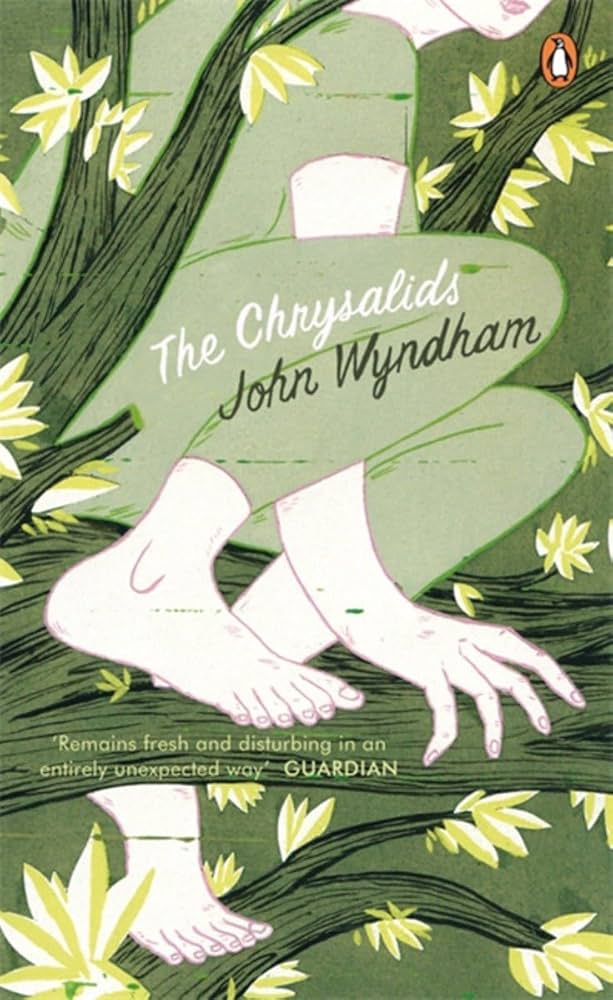
The Chrysalids
In The Chrysalids, John Wyndham crafts a chilling post-apocalyptic world where genetic purity is enforced with religious fervor. Set in Waknuk, a farming community in a radiation-scarred future, the story follows David Strorm, a boy who hides a dangerous secret: he possesses telepathic abilities—a mutation punishable by exile or death in his rigid society.
When David befriends Sophie, a girl with an extra toe, and later discovers a network of other “deviants” like himself, he realizes the terrifying truth: Waknuk’s obsession with purity is a lie. As the community’s witch hunts intensify, David and his friends must flee toward Sealand (New Zealand), a rumored land where mutations are the norm.
A gripping tale of persecution, survival, and evolution, The Chrysalids questions what it means to be human in a world that fears difference.
Description
- “The Chrysalids” by John Wyndham is a post-apocalyptic science fiction novel set in a future society that strictly enforces genetic purity. The story follows David Strorm, a young boy who discovers he possesses telepathic abilities, considered a dangerous mutation in his rigidly orthodox community. As David and others like him face persecution, they must navigate a world where deviation from the norm is ruthlessly eradicated. The novel explores themes of intolerance, survival, and the definition of humanity, offering a poignant critique of ideological extremism. Wyndham’s work remains significant for its timeless examination of societal fears and the consequences of blind conformity.
FAQs
- What is the main theme of The Chrysalids?
- • The novel explores themes of genetic mutation, intolerance, and the consequences of rigid societal norms in a post-apocalyptic world. It follows a young boy, David, who discovers he has telepathic abilities in a society that persecutes any form of physical or mental deviation.
- What is the setting of The Chrysalids?
- • The story is set in a dystopian future after a catastrophic event referred to as “Tribulation.” Society has regressed to a strict, agrarian lifestyle, and any form of genetic mutation is considered blasphemous and destroyed.
- Who is the protagonist of The Chrysalids?
- • The protagonist is David Strorm, a young boy who begins to question the rigid beliefs of his society after discovering his telepathic abilities and meeting others like him, including his cousin Rosalind and a girl named Sophie.
- What makes The Chrysalids unique compared to other dystopian novels?
- • Unlike many dystopian stories, The Chrysalids focuses on the psychological and emotional struggles of its characters, particularly the fear of persecution for being different. It blends science fiction with deep moral and philosophical questions about humanity and tolerance.
- Is The Chrysalids part of a series?
- • No, The Chrysalids is a standalone novel, though it shares thematic elements with John Wyndham’s other works, such as The Day of the Triffids and The Midwich Cuckoos.
- What age group is The Chrysalids suitable for?
- • The book is generally recommended for young adults and older readers due to its complex themes and dystopian setting. However, its engaging narrative and relatable protagonist make it accessible to mature middle-grade readers as well.
- What is the significance of the title The Chrysalids?
- • The title refers to the idea of transformation and evolution, much like a chrysalis (a stage in a butterfly’s life cycle). It symbolizes the potential for humanity to evolve beyond its current state, despite societal resistance to change.
Quotes
- “When I was quite small I would sometimes dream of a city—which was strange because it began before I even knew what a city was. But this city, clustered on the curve of a big blue bay, would come into my mind.” — John Wyndham, The Chrysalids
- “She shook her head, and told me that there was no such place—not now. But, perhaps, she suggested, I could somehow be dreaming about times long ago.” — John Wyndham, The Chrysalids
- “People in our district had a very sharp eye for the odd, or the unusual, so that even my left-handedness caused slight disapproval.” — John Wyndham, The Chrysalids
- “I was a normal little boy, growing up in a normal way, taking the ways of the world about me for granted. And I kept on like that until the day I met Sophie.” — John Wyndham, The Chrysalids
- “The bank was no puzzle to me then: it was far too big for me to think of as a thing that men could have built, nor had it ever occurred to me to connect it with the wondrous doings of the Old People whom I sometimes heard about.” — John Wyndham, The Chrysalids
- Chapter 1 2,203 Words
- Chapter 2 2,251 Words
- Chapter 3 2,408 Words
- Chapter 4 2,071 Words
- Chapter 5 2,134 Words
- Chapter 6 2,144 Words
- Chapter 7 2,109 Words
- Chapter 8 2,226 Words
- Chapter 9 2,358 Words
- Chapter 10 2,468 Words
- Chapter 11 2,262 Words
- Chapter 12 2,160 Words
- Chapter 13 2,158 Words
- Chapter 14 2,060 Words
- Chapter 15 2,516 Words
- Chapter 16 2,128 Words
- Chapter 17 2,232 Words
-
Never Let Me Go: In Never Let Me Go, Kazuo Ishiguro weaves a haunting and introspective tale set in an alternate-reality 1990s England, where Kathy…
-
The Chrysalids: In The Chrysalids, John Wyndham crafts a chilling post-apocalyptic world where genetic purity is enforced with religious fervor.…
-
The Giver of Stars: Set in the rugged mountains of 1930s Kentucky, The Giver of Stars follows Alice Wright, a spirited Englishwoman who escapes her…
-
The Children of Men: In The Children of Men, P.D. James crafts a haunting dystopian vision set in 2021, where humanity faces extinction after decades of…
-
The Hunger Games: In The Hunger Games, Katniss Everdeen, a 16-year-old girl from the impoverished District 12, volunteers to take her younger sister’s…
-
The Death Cure: In The Death Cure, the harrowing conclusion to the Maze Runner trilogy, Thomas and his friends escape WICKED’s…
-
Brave New World: In Brave New World, Aldous Huxley crafts a chilling vision of a dystopian future where society is engineered for stability and…
-
Gregor and the Curse of the Warmbloods: In Gregor and the Curse of the Warmbloods, Gregor returns to the Underland on a desperate mission: a deadly plague called the…
-
Gregor and the Marks of Secret: In Gregor and the Marks of Secret, Gregor returns to the Underland for a mission that begins as a rescue—and spirals into a chilling…
-
Gregor and the Code of Claw: In the epic conclusion to the Underland Chronicles, Gregor faces his most harrowing challenge yet as the Underland teeters on…