
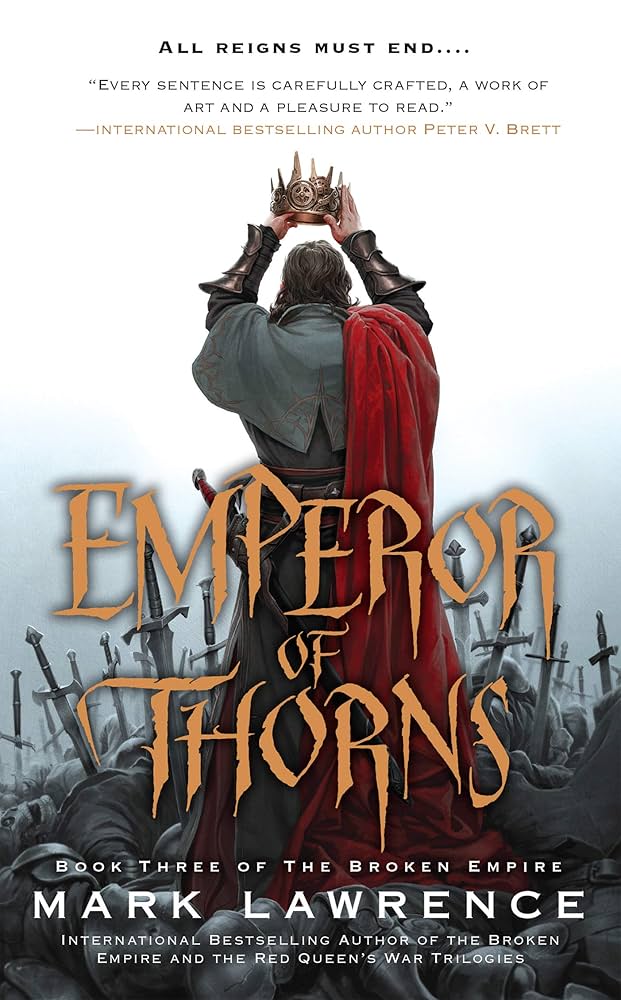
Emperor of Thorns (The Broken Empire, Book 3)
Emperor of Thorns is the explosive conclusion to Mark Lawrence’s Broken Empire trilogy, where Jorg Ancrath—the most ruthless and compelling antihero in modern fantasy—makes his final play for ultimate power. Now a hardened king at just twenty years old, Jorg marches toward the Congression, where the Hundred Kingdoms’ rulers will vote to crown an emperor. But his path is littered with corpses, betrayals, and the ghosts of his own brutal past:
- The Dead King’s necrotic empire spreads like a plague
- The Hidden Library’s apocalyptic secrets threaten all reality
- Jorg’s stolen memories resurface with devastating consequences
Told through Lawrence’s signature razor-sharp prose and dual timelines, this finale forces Jorg to confront whether he’s the world’s destroyer or its last, unlikely hope. With a climax that redefines grimdark fantasy, Emperor of Thorns cements Jorg’s legacy as a protagonist who’s equal parts monster, genius, and tragic product of a broken world.
Description
- “Emperor of Thorns” concludes Mark Lawrence’s dark fantasy trilogy, The Broken Empire, following the ruthless King Jorg Ancrath as he seeks to unite a fractured empire. The narrative intertwines Jorg’s brutal political maneuvering with flashbacks revealing his tragic past. Themes of power, redemption, and the cost of ambition are explored as Jorg confronts supernatural threats and moral dilemmas. The novel’s grim tone, intricate world-building, and morally complex protagonist cement its place in the grimdark subgenre. A gripping finale to a series praised for its unflinching portrayal of violence and humanity.
FAQs
- What is “Emperor of Thorns” about?
- • “Emperor of Thorns” is the third and final book in “The Broken Empire” trilogy by Mark Lawrence. It follows Jorg Ancrath, a ruthless and cunning protagonist, as he navigates political intrigue, supernatural forces, and his own dark past to claim the throne of the Broken Empire. The story culminates in the Congression, where rulers convene to vote for a new emperor.
- Do I need to read the previous books in the series before this one?
- • Yes, “Emperor of Thorns” is the conclusion to the trilogy, and it heavily relies on events and character development from the first two books, “Prince of Thorns” and “King of Thorns.” The prologue and “The Story So Far” section provide a recap, but reading the series in order is recommended for full context.
- Who is Jorg Ancrath, and why is he significant?
- • Jorg Ancrath is the antihero protagonist of the series. A brutal yet intelligent ruler, he seeks power in a fractured empire while grappling with trauma, guilt, and supernatural threats. His journey is marked by morally ambiguous choices, making him a compelling and controversial figure.
- What themes are explored in “Emperor of Thorns”?
- • The book delves into themes of power, redemption, and the consequences of violence. It also explores the blurred lines between magic and science, as the world’s “magic” stems from ancient technology left by the Builders. Jorg’s internal struggles and external battles drive these themes forward.
- Is there supernatural or magical elements in the story?
- • Yes, the Broken Empire features necromancy, ghosts of the Builders (ancient scientists), and individuals with will-based powers. The Dead King and other entities manipulate events from the shadows, blending dark fantasy with post-apocalyptic elements.
- How does the trilogy conclude?
- • Without spoilers, the finale ties together Jorg’s personal arc and the empire’s fate, with high stakes, brutal confrontations, and revelations about the world’s origins. The Congression and Jorg’s rivalry with the Dead King play pivotal roles.
- Is this book suitable for all readers?
- • No. The series contains graphic violence, mature themes, and morally complex characters. It’s recommended for adult readers who enjoy dark, gritty fantasy with an unflinching protagonist.
- Are there plans for more books in this universe?
- • While “Emperor of Thorns” concludes Jorg’s story, Mark Lawrence has written other series set in the same universe, such as “The Red Queen’s War,” which explores new characters and regions of the Broken Empire.
Quotes
- “Is this what death is like? A cold whiteness, for ever and ever amen?” — Mark Lawrence
- “A core of selfishness bound Kai to his existence. He knew himself well enough to admit that. An old strand of greed, an inability to let go.” — Mark Lawrence
- “The sky-sworn could so easily lose themselves in the vastness of the heavens. Many did, leaving flesh to die and haunting the empty spaces above.” — Mark Lawrence
- “They made it possible for a person’s will to affect matter and energy directly.” — Mark Lawrence (on the Builders’ legacy)
- “Every four years the rulers of the hundred fragments of empire convene in the capital Vyene for Congression – a truce period during which they vote for a new emperor.” — Mark Lawrence (on the political tension of the Broken Empire)
- Chapter 1: The Story So Far 2,273 Words
- Chapter 2: Prologue 2,213 Words
- Chapter 3 2,115 Words
- Chapter 4 2,296 Words
- Chapter 5 2,314 Words
- Chapter 6 2,450 Words
- Chapter 7 2,058 Words
- Chapter 8 2,352 Words
- Chapter 9 2,552 Words
- Chapter 10 2,489 Words
- Chapter 11 2,197 Words
- Chapter 12 2,370 Words
- Chapter 13 2,353 Words
- Chapter 14 2,332 Words
- Chapter 15 2,054 Words
- Chapter 16 2,215 Words
- Chapter 17 2,248 Words
- Chapter 18 2,264 Words
- Chapter 19 2,269 Words
- Chapter 20 2,460 Words
- Chapter 21 2,436 Words
- Chapter 22 2,062 Words
- Chapter 23 2,165 Words
- Chapter 24 2,281 Words
- Chapter 25 2,372 Words
- Chapter 26 2,074 Words
- Chapter 27 2,376 Words
- Chapter 28 2,220 Words
- Chapter 29 2,308 Words
- Chapter 30 2,374 Words
- Chapter 31 1,988 Words
- Chapter 32 2,249 Words
- Chapter 33 2,132 Words
- Chapter 34 2,282 Words
- Chapter 35 2,516 Words
- Chapter 36 2,373 Words
- Chapter 37 2,288 Words
- Chapter 38 2,280 Words
- Chapter 39 2,358 Words
- Chapter 40 2,198 Words
- Chapter 41 2,090 Words
- Chapter 42 2,141 Words
- Chapter 43 2,201 Words
- Chapter 44 2,285 Words
- Chapter 45 2,319 Words
- Chapter 46 2,232 Words
- Chapter 47 2,293 Words
- Chapter 48 2,114 Words
- Chapter 49 2,323 Words
- Chapter 50 77 Words
- Chapter 51 2,397 Words
- Chapter 52 2,202 Words
- Chapter 53 2,083 Words
- Chapter 54 1,956 Words
- Chapter 55 2,464 Words
- Chapter 56 2,226 Words
-
Never Let Me Go: In Never Let Me Go, Kazuo Ishiguro weaves a haunting and introspective tale set in an alternate-reality 1990s England, where Kathy…
-
The Chrysalids: In The Chrysalids, John Wyndham crafts a chilling post-apocalyptic world where genetic purity is enforced with religious fervor.…
-
The Giver of Stars: Set in the rugged mountains of 1930s Kentucky, The Giver of Stars follows Alice Wright, a spirited Englishwoman who escapes her…
-
The Children of Men: In The Children of Men, P.D. James crafts a haunting dystopian vision set in 2021, where humanity faces extinction after decades of…
-
The Hunger Games: In The Hunger Games, Katniss Everdeen, a 16-year-old girl from the impoverished District 12, volunteers to take her younger sister’s…
-
The Death Cure: In The Death Cure, the harrowing conclusion to the Maze Runner trilogy, Thomas and his friends escape WICKED’s…
-
Brave New World: In Brave New World, Aldous Huxley crafts a chilling vision of a dystopian future where society is engineered for stability and…
-
Gregor and the Curse of the Warmbloods: In Gregor and the Curse of the Warmbloods, Gregor returns to the Underland on a desperate mission: a deadly plague called the…
-
Gregor and the Marks of Secret: In Gregor and the Marks of Secret, Gregor returns to the Underland for a mission that begins as a rescue—and spirals into a chilling…
-
Gregor and the Code of Claw: In the epic conclusion to the Underland Chronicles, Gregor faces his most harrowing challenge yet as the Underland teeters on…