
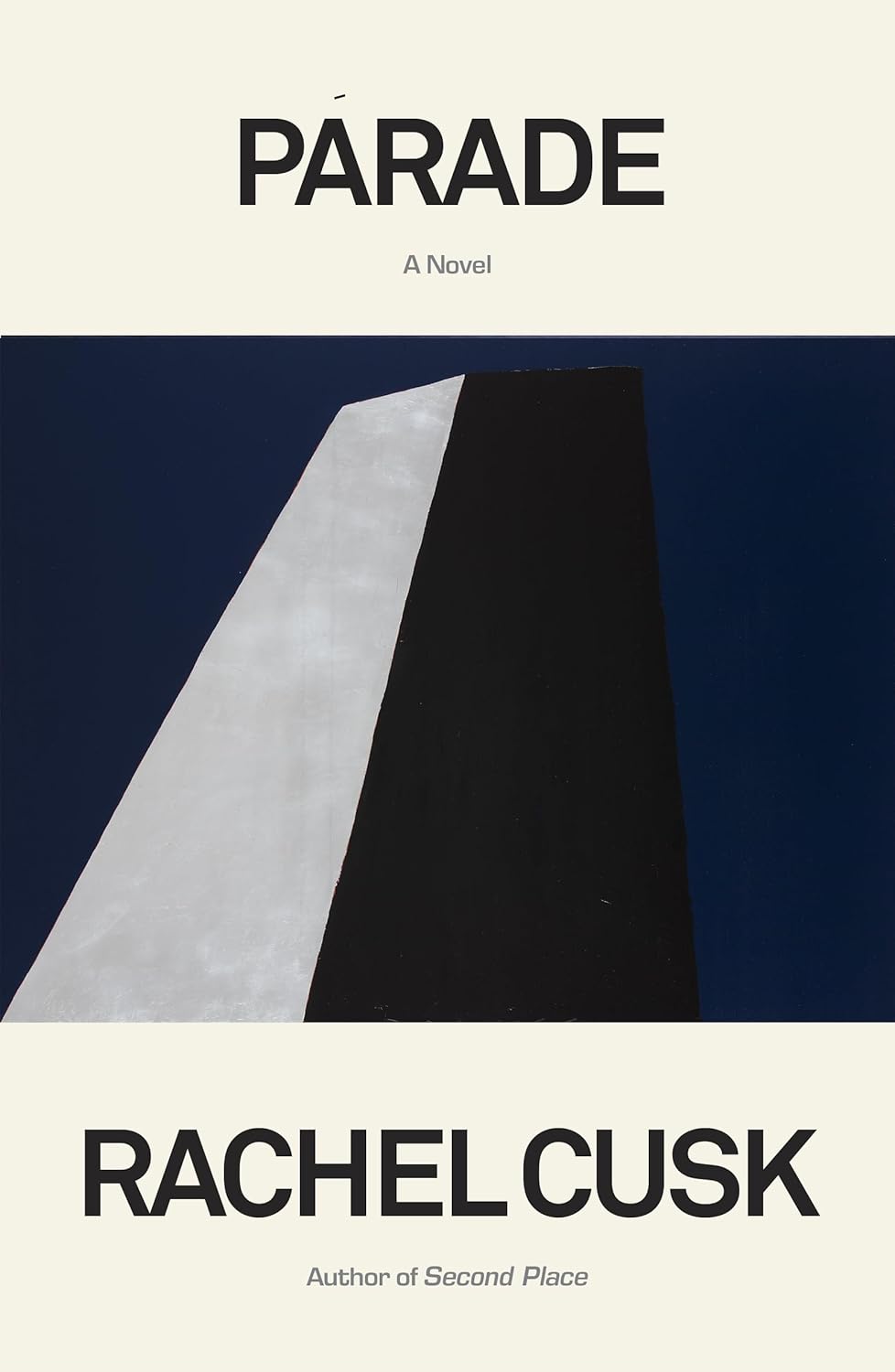
Parade
Parade is a novel by Rachel Cusk, the acclaimed author of the Outline trilogy, known for her sharp, introspective prose and deconstruction of narrative conventions. In this work, Cusk continues her exploration of identity, perception, and the elusive nature of storytelling, weaving together fragmented yet interconnected narratives that blur the boundaries between fiction and autobiography.
Rachel Cusk’s Parade is a sharp and thought-provoking novel that dissects the nature of performance, identity, and art. Following a renowned theater director as she navigates a shifting landscape of creative ambition and personal disillusionment, the novel explores the tension between authenticity and artifice. As she engages with a cast of enigmatic characters—actors, critics, and admirers—her own sense of self begins to blur, raising profound questions about the roles we play in life. With Cusk’s signature precise prose and psychological depth, Parade is a mesmerizing meditation on the boundaries between reality and illusion.
Description
- Parade is a novel by Rachel Cusk, the acclaimed author of the Outline trilogy, known for her sharp, introspective prose and deconstruction of narrative conventions. In this work, Cusk continues her exploration of identity, perception, and the elusive nature of storytelling, weaving together fragmented yet interconnected narratives that blur the boundaries between fiction and autobiography.
- The novel unfolds through a series of vignettes, shifting perspectives, and meditative reflections, often centered around themes of art, family, and the tension between self-invention and societal expectations. One of the central threads follows a filmmaker, G, who adopts pseudonyms to escape the weight of his past, mirroring Cusk’s own preoccupation with authorship and the masks people wear. Another recurring strand examines the legacy of a domineering mother whose death leaves her children grappling with unresolved grief and the stories she imposed upon them.
- Stylistically, Parade eschews traditional plot in favor of a mosaic structure, where seemingly disparate scenes—a dinner conversation, a filmmaker’s creative crisis, a mother’s fabricated past—resonate with deeper thematic echoes. Cusk’s prose is precise and philosophical, probing the ways people construct and perform their lives, often in defiance of reality. The novel challenges conventional notions of narrative authority, suggesting that truth is not fixed but refracted through multiple, sometimes contradictory, lenses.
- With its intellectual rigor and emotional depth, Parade solidifies Cusk’s reputation as a bold innovator of contemporary fiction. It is a book about the stories we tell to survive, the identities we cling to or discard, and the haunting presence of those who shape us—even in their absence. Readers familiar with Cusk’s earlier work will recognize her signature style, while newcomers will encounter a provocative and deeply original meditation on art, memory, and the self.
FAQs
- 1. What is Parade about?
- Parade explores identity, art, and perception through fragmented narratives, blending autobiography, fiction, and philosophical inquiry. It questions how we construct selves and stories, particularly through the lens of an artist (often a stand-in for Cusk herself).
- 2. How does Rachel Cusk’s style in Parade differ from her earlier work?
- Like her Outline trilogy, Parade rejects traditional plot but pushes further into abstraction and metafiction. It’s more overtly concerned with artistic creation, using aliases, dreams, and shifting perspectives to destabilize authorship.
- 3. Who is "G" in the book?
- G is a recurring figure—a filmmaker who hides his identity—serving as a proxy for Cusk’s themes of anonymity and artistic evasion. His struggles mirror the book’s interrogation of whether true detachment in art is possible.
- 4. Why does Cusk blur autobiography and fiction?
- To challenge the illusion of a fixed self. Scenes of motherhood, death, and artistic failure feel personal but are abstracted to explore universal tensions: control vs. surrender, visibility vs. erasure.
- 5. What does the title Parade signify?
- A "parade" suggests performance and spectacle—the ways people (and artists) present themselves. It also hints at the book’s structure: a procession of loosely connected vignettes, each revealing and concealing in equal measure.
- 6. How does the book address motherhood?
- Motherhood is depicted as a site of contradiction: a creative act that obliterates the mother’s autonomy. The narrator’s mother, like G, seeks control through self-destruction, leaving a legacy of unresolved grief.
- 7. Is Parade a novel, memoir, or essay collection?
- It defies genre, merging autofiction, essayistic musings, and allegory. Cusk calls it "a book without a form," reflecting her rejection of narrative conventions.
Quotes
- On Identity & Art
- “To conceal identity is to take from the world, without paying the costs of self-declaration.”
- —On the ethical dilemma of artistic anonymity.
- “The writer writes about what he already knows and has decided is there. He pretends he doesn’t.”
- —A meta-critique of fiction’s illusions.
- On Perception & Reality
- “Being seen while seeing, they are doubly illuminated by the light of perception.”
- —On the voyeuristic nature of existence and art.
- “If it only happened once, it didn’t happen at all.”
- —Memory’s unreliability as a theme.
- On Motherhood & Legacy
- “She wanted us to be finished but we could never be finished.”
- —On the mother’s futile desire to control her children’s narratives.
- “Her flesh was a sort of outcome, the result of all the things that had been done to her body during her life.”
- —The body as a site of accumulated history.
- On Death & Absence
- “The violence of death had the appearance of a strange generosity.”
- —The paradoxical freedom in loss.
- “We resumed our lives after the funeral as though nothing had occurred.”
- —The disconnect between ritual and real grief.
- On Art & Failure
- “He wanted simply to record. But recording, he found, was another kind of violence.”
- —G’s realization that even passive observation distorts.
- “Invisibility was his conduit to self-expression, though it had done nothing so far but consign his work to oblivion.”
- —The cost of artistic detachment.
- The Stuntman 3,812 Words
- The Midwife 3,096 Words
- The Diver 3,243 Words
- The Spy 3,732 Words
-
Never Let Me Go: In Never Let Me Go, Kazuo Ishiguro weaves a haunting and introspective tale set in an alternate-reality 1990s England, where Kathy…
-
The Chrysalids: In The Chrysalids, John Wyndham crafts a chilling post-apocalyptic world where genetic purity is enforced with religious fervor.…
-
The Giver of Stars: Set in the rugged mountains of 1930s Kentucky, The Giver of Stars follows Alice Wright, a spirited Englishwoman who escapes her…
-
The Children of Men: In The Children of Men, P.D. James crafts a haunting dystopian vision set in 2021, where humanity faces extinction after decades of…
-
The Hunger Games: In The Hunger Games, Katniss Everdeen, a 16-year-old girl from the impoverished District 12, volunteers to take her younger sister’s…
-
The Death Cure: In The Death Cure, the harrowing conclusion to the Maze Runner trilogy, Thomas and his friends escape WICKED’s…
-
Brave New World: In Brave New World, Aldous Huxley crafts a chilling vision of a dystopian future where society is engineered for stability and…
-
Gregor and the Curse of the Warmbloods: In Gregor and the Curse of the Warmbloods, Gregor returns to the Underland on a desperate mission: a deadly plague called the…
-
Gregor and the Marks of Secret: In Gregor and the Marks of Secret, Gregor returns to the Underland for a mission that begins as a rescue—and spirals into a chilling…
-
Gregor and the Code of Claw: In the epic conclusion to the Underland Chronicles, Gregor faces his most harrowing challenge yet as the Underland teeters on…