
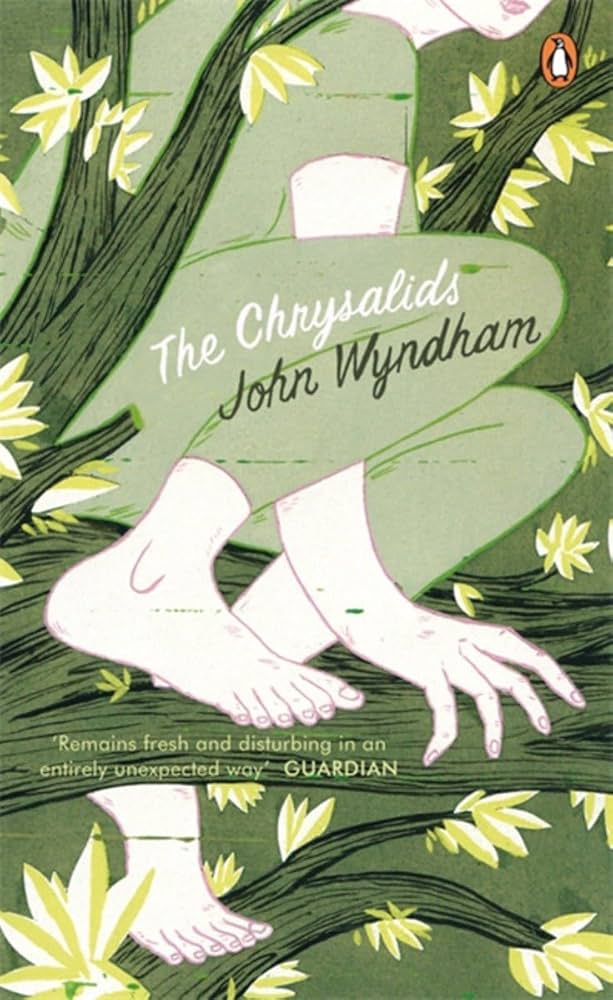
The Chrysalids
Chapter 7
by Wyndham, JohnThe chapter begins with the unexpected arrival of the narrator’s sister, Petra, whose birth is shrouded in secrecy and societal conventions. The household pretends not to notice the baby’s cries until an inspector can certify her as a “true human baby” free of deviations. The tension escalates as the inspector delays his visit, exacerbating the family’s anxiety, especially given past failures to secure certification. The narrator’s father grows increasingly angry but is constrained by societal norms, while the household tiptoes around him, avoiding any mention of the baby.
The inspector’s eventual arrival does little to ease the tension. He takes his time examining Petra, prolonging the family’s suspense. After a meticulous inspection, he reluctantly issues the certification, though his hesitation suggests lingering doubts. With the certificate finally in hand, the family can openly acknowledge Petra’s existence, and they gather for prayers of thanksgiving. The narrator, however, remains skeptical about the inspector’s certainty, noting Petra’s wrinkled appearance.
A few days later, the narrator stumbles upon a troubling family secret. While hiding in a room adjacent to their mother’s, they witness their Aunt Harriet arriving with a mysterious white bundle. The narrator reflects on Aunt Harriet’s softer demeanor compared to their mother, hinting at a more compassionate and approachable nature. The chapter ends abruptly as Harriet enters the house, leaving the narrator—and the reader—to wonder about the significance of the bundle and the unresolved tension.
The chapter masterfully explores themes of societal pressure, secrecy, and familial tension. The rigid certification process for newborns underscores a dystopian reality where conformity is enforced, and deviations are erased. The narrator’s observations reveal a family strained by unspoken rules and past traumas, while Aunt Harriet’s arrival introduces a potential catalyst for further conflict or revelation. The prose maintains a tense, observational tone, drawing the reader into the narrator’s constrained world.
FAQs
1. What is the significance of the inspector’s certificate in this society, and how does it affect the family’s behavior?
Answer:
The inspector’s certificate serves as official validation that a newborn is a “true human being” without deviations, a crucial requirement in this society. Without it, the baby’s existence cannot be acknowledged, and the incident must be treated as though it never happened. This creates immense anxiety for the family, as seen when they pretend it’s an ordinary day while awaiting inspection. The father’s status is also at stake—delays in certification fuel speculation and damage his reputation. The family’s tense behavior (tiptoeing around, forced normalcy) demonstrates how this bureaucratic process controls personal lives and social standing.2. Analyze the power dynamics between the father and the inspector. How does the chapter illustrate this tension?
Answer:
The inspector wields bureaucratic power to retaliate against the father’s past insults by delaying his visit—a subtle but effective humiliation. Though the father holds social standing, he is powerless to demand urgency without breaching decorum. His suppressed rage (exploding over trivial matters, “nearly strangled” politeness) contrasts with the inspector’s leisurely control (chatting about weather, deliberate paperwork). The inspector’s “air of uncertainty” when signing the certificate further underscores his authority to judge the family’s worth. This highlights a society where institutional power can undermine even privileged individuals.3. How does the narrator’s perspective shape our understanding of Petra’s arrival? Compare his observations to the adults’ reactions.
Answer:
The child narrator notices details adults avoid: the unmentioned baby’s cry, the “unattributable expectation,” and Petra’s wrinkled appearance that makes him question the inspector’s certainty. His confusion contrasts with the adults’ performative normalcy (e.g., attributing the mother’s bedrest to a “slight cold”). While the family focuses on social consequences, his innocent observations—like wondering if Petra looks “normal”—reveal the absurdity of the certification system. His hidden vantage point (eavesdropping, strategic hiding) also exposes truths the adults suppress, such as the family’s history of failed certifications.4. What societal norms are revealed through Aunt Harriet’s brief appearance, and what might her “white bundle” symbolize?
Answer:
Aunt Harriet’s arrival hints at taboo realities beneath the society’s rigid facade. Her “white bundle” likely symbolizes another baby—possibly one seeking certification through covert means, given the family’s past failures. Her softer demeanor compared to the mother (described as a more approachable version) suggests dissent from societal harshness. The narrator’s hiding spot near the parents’ room, where he overhears her, implies secrecy around reproduction. This foreshadows deeper conflicts about deviation and the extreme measures families take to conform.5. Why does the chapter emphasize the performative aspects of the family’s behavior (e.g., prayers, pretending normalcy)?
Answer:
The forced rituals—thanksgiving prayers after certification, pretending not to hear the baby—reveal a society where survival depends on maintaining appearances. The bell-ringing and public prayers contrast with earlier private anxiety, showing how conformity is enforced through collective performance. The father’s outbursts, redirected at trivialities, demonstrate the strain of this duality. Such acts underscore the theme of societal control: even relief must be expressed in sanctioned ways, and any deviation (like acknowledging anxiety prematurely) risks exclusion or shame.
Quotes
1. “No one, indeed, would dream of mentioning the matter openly until the inspector should have called to issue his certificate that it was a human baby in the true image. Should it unhappily turn out to violate the image and thus be ineligible for a certificate, everyone would continue to be unaware of it, and the whole regrettable incident would be deemed not to have occurred.”
This quote introduces the dystopian society’s chilling practice of certifying newborns as “true humans,” highlighting the dehumanizing bureaucracy and the collective pretense required to maintain social norms. It sets the tone for the chapter’s central conflict.
2. “It is very unwise for even a righteous man to quarrel with his local inspector and call him names in public. The inspector has too many ways of hitting back.”
This reveals the power dynamics in this society, where inspectors wield life-altering authority over families. The quote underscores the tension between social status and institutional power, explaining the father’s helpless anger.
3. “She looked so pink and wrinkled to me that I did not see how the inspector could have been quite sure about her. However, there was nothing obviously wrong with her, so she had got her certificate.”
This ironic observation from the young narrator questions the arbitrary nature of the certification system while highlighting how even survival depends on superficial judgments. It follows the climactic inspection scene.
4. “I used to feel when I looked at her that I was seeing my mother as she might have been—as, I thought, I would have liked her to be.”
This poignant reflection about Aunt Harriet introduces the theme of idealized alternatives and unfulfilled potential, foreshadowing later revelations about family secrets and societal pressures.