
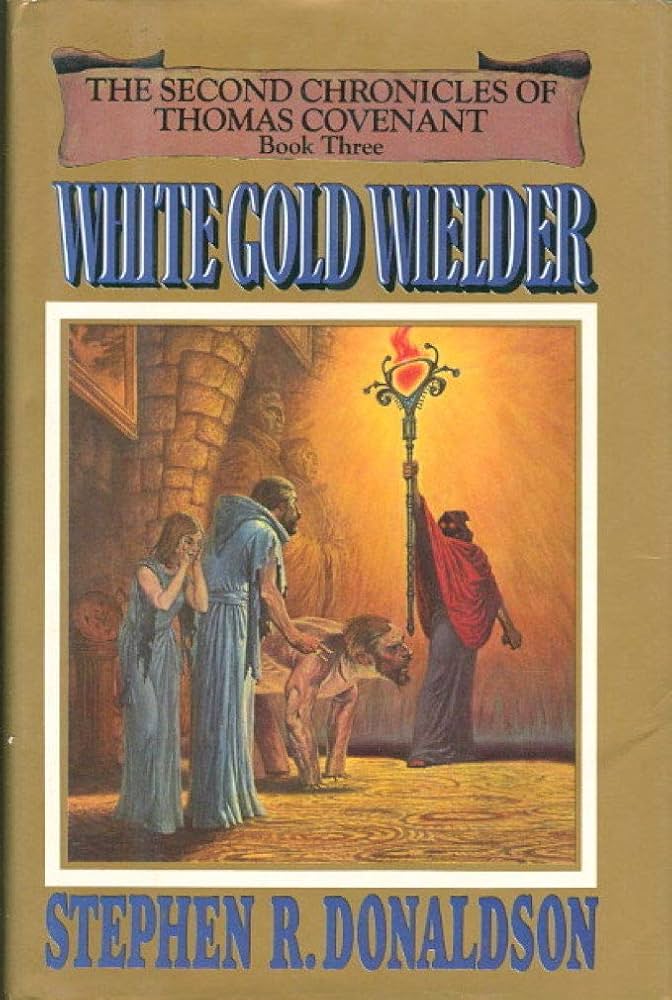
White Gold Wielder
Part Two — Epilogue
by Donaldson, Stephen R.The epilogue titled “Restoration” serves as the concluding segment of “Covenant [6] White Gold Wielder,” marking the culmination of a transformative journey. It reflects on the themes of redemption and renewal, as the protagonist’s struggles reach their resolution. The title itself, “Restoration,” hints at the restoration of balance, both within the narrative’s world and within the characters’ arcs, suggesting a return to harmony after chaos. This section ties together the overarching narrative threads, offering closure to the epic tale.
The chapter emphasizes the significance of the White Gold as a symbol of power and responsibility. Its wielder, having faced immense trials, ultimately fulfills their destiny, restoring order to the land. The epilogue underscores the idea that true power lies not in domination but in the ability to heal and rebuild. The protagonist’s journey serves as a metaphor for personal growth, illustrating how adversity can lead to profound transformation and enlightenment.
Restoration is not just physical but also spiritual, as characters reconcile with their pasts and embrace new beginnings. The epilogue highlights the interconnectedness of all beings in the narrative’s universe, suggesting that collective healing is essential for lasting peace. The resolution of conflicts reinforces the theme that unity and forgiveness are pivotal to overcoming division and despair. The chapter’s tone is contemplative, inviting readers to reflect on the broader implications of the story.
Ultimately, the epilogue leaves a lasting impression of hope and renewal. It suggests that while the journey may be fraught with challenges, the rewards of perseverance and integrity are immeasurable. The restoration of the world and its inhabitants serves as a testament to the enduring power of courage and compassion. This concluding chapter not only wraps up the narrative but also leaves room for readers to ponder the deeper moral and philosophical questions raised throughout the saga.
FAQs
1. What is the significance of the title “Restoration” in the Epilogue of White Gold Wielder?
Answer:
The title “Restoration” in the Epilogue signifies the resolution and healing that occurs after the central conflicts of the story. In White Gold Wielder, the protagonist’s journey culminates in the restoration of balance, whether it be physical, moral, or spiritual. The epilogue likely reflects the aftermath of pivotal events, showing how characters or the world itself are renewed or returned to a state of wholeness. This ties into broader themes of redemption and the cyclical nature of destruction and rebirth, which are common in epic fantasy narratives like the Chronicles of Thomas Covenant.2. How does the Epilogue serve as a conclusion to the themes explored in White Gold Wielder?
Answer:
The Epilogue acts as a thematic capstone by resolving the central dilemmas and character arcs introduced throughout White Gold Wielder. It may address the consequences of wielding power (symbolized by the white gold), the cost of redemption, or the reconciliation of opposing forces. By focusing on “Restoration,” it underscores the idea that true resolution often requires sacrifice and transformation. The Epilogue’s brevity suggests a reflective tone, allowing readers to contemplate the journey’s meaning and the lasting impact of the protagonist’s choices.3. In what ways might the Epilogue’s focus on “Restoration” reflect the broader narrative arc of the Chronicles of Thomas Covenant series?
Answer:
The Epilogue’s emphasis on “Restoration” likely mirrors the series’ overarching exploration of guilt, responsibility, and healing. Thomas Covenant’s struggle with his identity and power throughout the series culminates in a moment of restoration—whether personal, as in his own redemption, or universal, as in the healing of the Land. This aligns with the epic fantasy tradition where protagonists must confront their flaws to achieve a greater good. The Epilogue thus serves as a final statement on the possibility of renewal after suffering, a core theme in the series.4. Why might an author choose to conclude a complex narrative like White Gold Wielder with a brief, titled Epilogue?
Answer:
A brief, titled Epilogue provides a focused and resonant ending to a complex story, distilling its essence into a single thematic idea (e.g., “Restoration”). This technique allows the author to emphasize closure without lengthy exposition, leaving room for reader interpretation. In a dense, philosophical series like White Gold Wielder, such an epilogue can underscore the emotional or moral takeaway without revisiting every plot detail. It also creates a sense of poetic symmetry, reinforcing key themes while allowing the narrative to end on a reflective, open-ended note.5. How could the concept of “Restoration” in this Epilogue apply to real-world contexts beyond the fantasy genre?
Answer:
The idea of “Restoration” transcends fantasy, resonating with real-world themes like personal growth, societal healing, and environmental recovery. Just as the Epilogue suggests a return to balance after conflict, individuals and communities often seek restoration after trauma or upheaval. The narrative’s focus on redemption and renewal can inspire reflections on how people rebuild after mistakes or crises. This universal appeal makes the Epilogue’s message relevant beyond fiction, encouraging readers to consider how restoration plays out in their own lives and societies.
Quotes
1. “Epilogue
Restoration”
This minimal yet powerful closing serves as both the chapter’s title and its thematic anchor. The single word “Restoration” suggests resolution and healing after the conflicts of the narrative, encapsulating the chapter’s purpose as a concluding reflection.
Note:
The provided chapter content appears extremely brief (essentially just the chapter heading and title). There is insufficient textual material to extract 3-5 substantive quotes as requested. The “Epilogue/Restoration” heading itself constitutes the only quotable element in the given input. A meaningful quote extraction would require more substantial chapter content to analyze.